
Last Night @ School Committee

A bite-sized summary of Boston School Committee meetings, and "Deep Dives" on the biggest issues impacting public schools nationwide.


Accountability, Technology, and Transportation Issues
Last Night @ School Committee - October 14th, 2026
At last night’s Boston School Committee meeting, we saw a preview of a proposed bell-to-bell ban on cell phones, further discussion surrounding word on the OIG report, and a lengthy discussion of new accountability and achievement results. Hopefully you’ve listened to the podcast, because in this post we will be digging deeper into the accountability results, providing more context and identifying what the district missed.
During her mandatory report, Superintendent Skipper began her remarks by announcing a draft policy for a phone ban that will be submitted to the Committee in early 2027. This has been a hot topic not just in Boston, but around the nation. While a state bill to ban phones seems dead on Beacon Hill, districts like Brockton have had bans enacted for almost two years now, with some success. That said, studies on phone bans have been somewhat mixed. A recently released study of 17,000 Indian college students found some modest academic gains amongst the lowest performers, equivalent to a “0.073 SD increase in GPA.” As the paper points out, “the difference between an average and a very good teacher over one academic year is roughly 0.20 SD.” An NBER paper from earlier this year was a bit less positive, pointing to no real long-term impact on academics or attendance. That said, implementation matters (if pouches are used) and changes to student behavior and classroom environment may be more important than academics. Phone bans are also a policy with minimal costs or practical downsides, and thus any improvement may make the policy worth it.
Accountability
Every year, the Department of Elementary and Secondary Education (DESE) releases accountability data, which ranks and categorizes all schools and districts according to a set of achievement metrics. Broadly, districts and individual schools are classified as either “requiring assistance or intervention” or not needing intervention. Schools are ranked with an “accountability percentile” from 1 (the lowest) to 99, which indicates overall performance relative to other schools. Generally, a school in the bottom 10th percentile is classified as being in need of assistance.
As district officials noted, accountability rankings barely moved from 2025 to 2026 in Boston. Of the 86 schools with a score in both years, 39 improved, 40 declined, and 7 stayed flat. But we can also be more specific about which schools saw the biggest shifts. Many in the bottom deciles improved substantially: the Ellis, Margarita Muniz, Russell, and Lee K-8 to name a few. The largest single-year gains came from the Hernandez, Mozart, Bates, and Haley schools.
On the other hand, some schools saw declines; the largest in the last year included the Winthrop, Hurley, and Gardner schools. And while the district highlighted schools that have seen consistent growth since 2023, it is also worth highlighting which schools have seen the largest declines over that period and are in the need of the most help. Since 2023, five schools have declined by more than 10 points: Gardner (-26), Mendell (-21), Hurley (-20), Tynan (-17), Kilmer (-12), Quincy Elementary (-10). The Gardner fell enough that it is now officially "requiring assistance” according to DESE.
Tools
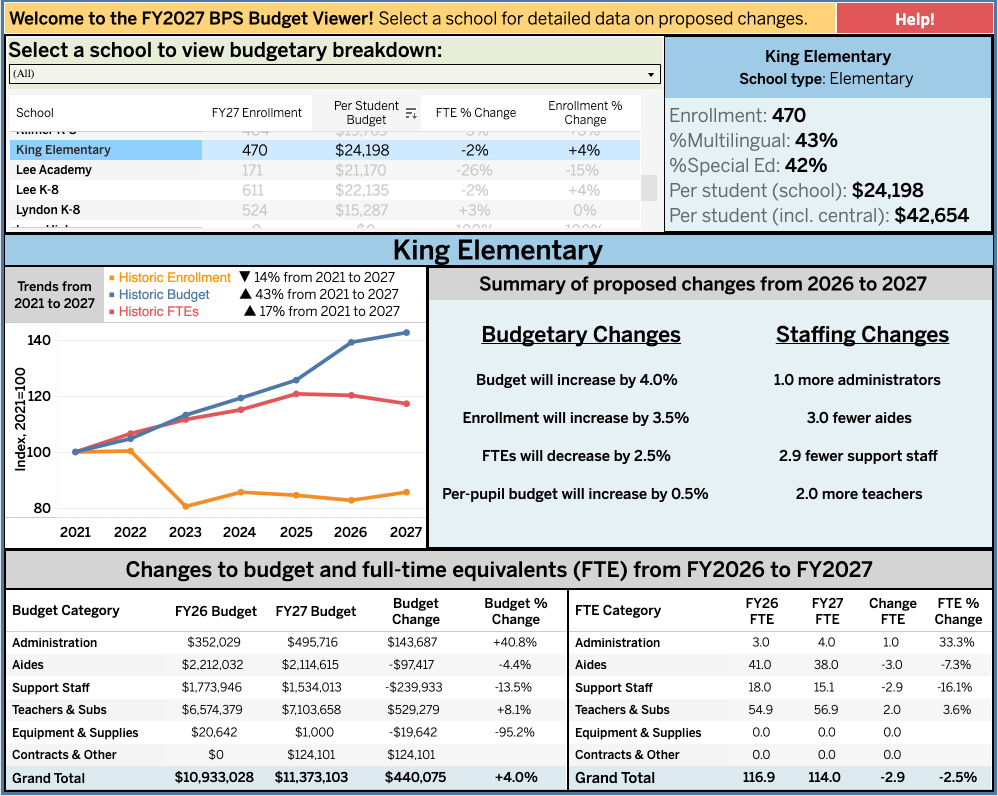
The 2027 proposed budget for Boston Public Schools is over $1.7B, providing funding for over 10,000 employees responsible for more than 46,000 students across 105 schools. Comprising over 40% of the city’s budget and shouldering responsibility for educating tomorrow’s leaders, understanding the changes in the budget are crucial. The district makes many of its financial documents publicly available, although not always in an accessible or easily understandable format. The tool below combines multiple sources of data (chiefly the FY27 budget sheet and the budget book) in an easily browsable format to help students, teachers, policymakers, and concerned citizens to understand the changes in the coming fiscal year.
School Database allows you to explore enrollment, budget, and staffing changes for individual schools from 2026 to 2027. The dashboard shows district-wide changes, and searching for or clicking on individual schools in the list will bring up school-specific data.
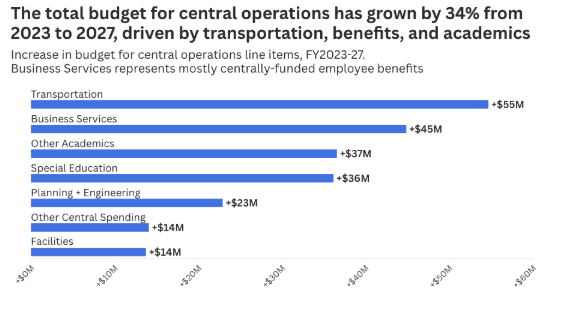
BudgetBreakdown details how the FY2027 budget is spread between direct school funding and central office funding, and how each broad category and specific line item is changing. Hovering over each box provides more information, and filters on the right allow for a closer view.
Budget Over Time will detail how each broad budget category has changed since 2019, and which portions of the budget have grown the fastest.

Methodology
Numbers may vary slightly from sources elsewhere. While it may be an error, it’s also possible that the underlying data has variations from source-to-source. As this tool attempts to unify disparate sources across times and departments, variation is a given. Some of the more common questions sources of inconsistency:
School inclusion: BPS, in its budget, includes a number of in-district charters (Boston Day and Evening Academy, Green Academy, Dudley Street Neighborhood School, and the Kennedy Academy for Health Careers) which are sometimes excluded from datasets. Given that these are funded and staffed by BPS, they are included here. School names and formats change over time, and while we strive to be consistent, this can create confusion.
Enrollment: This total varies based on when the students are counted, and totals in the beginning and end of the year may vary. As mentioned above, the inclusion of in-district charters can also add several hundred students.
Budget: We use the most recent FY27 budgets, but these are still subject to change and may vary between draft budgets. For historic budgets, we use current spending levels as opposed to adopted budgets, which can lead to variation.
Budget category: To create cross-time comparisons in the budget breakdown, we have attempted to group central budgeted functions as they are in the FY27 budget, as they were grouped differently in years past. These groups are unofficial, and while all individual line items remain as they appear, the category in which they appear may be unexpected.